Chinese AI Model API Cost Routing Guide (2026): GLM 5.2, DeepSeek V4 Flash, Claude Sonnet 5, and GPT-5.5
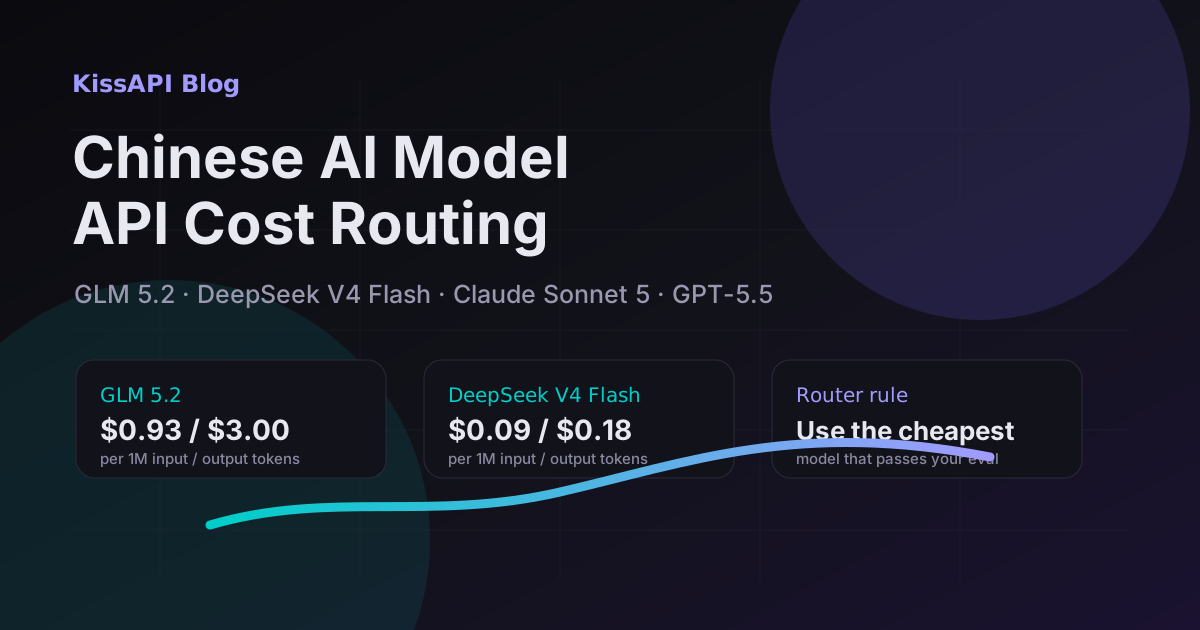
On July 7, 2026, CNBC reported that Chinese-built AI models are gaining ground with U.S. companies as OpenAI and Anthropic costs rise. The numbers are hard to ignore: OpenRouter token share for Chinese models has reportedly stayed above 30% each week since February 8, and CNBC said it has reached as high as 46%. Z.ai's GLM 5.2 also saw fast adoption after its June launch, with Vercel reporting roughly 27x daily token-volume growth and about 80x customer growth in its first full week.
The lesson for developers isn't "replace every model with the cheapest one." That's lazy architecture. The better move is routing: use cheaper models for work they can reliably pass, keep expensive frontier models for the tasks where they earn their price, and measure everything.
- CNBC reported on July 7, 2026 that Chinese AI models have stayed above 30% weekly token share on OpenRouter since February 8, 2026, with a peak near 46%.
- Z.ai GLM 5.2 costs about $0.93 per million input tokens and $3.00 per million output tokens through OpenRouter's DeepInfra route, with a 1,048,576-token context window.
- DeepSeek V4 Flash costs about $0.09 per million input tokens and $0.18 per million output tokens, with a 1,000,000-token context window according to current pricing trackers.
- OpenAI GPT-5.5 costs $5.00 per million input tokens and $30.00 per million output tokens for short context, with a 1,050,000-token context window.
- A production API router should fall back to Claude Sonnet 5, GPT-5.5, or another stronger model when cheap-model confidence is low.
The pricing table developers actually need
Here are the practical token prices to keep in your routing spreadsheet. Always re-check before a big deployment, because provider pricing changes fast.
| Model | Input price | Output price | Context window |
|---|---|---|---|
| DeepSeek V4 Flash | $0.09 per 1M tokens | $0.18 per 1M tokens | 1,000,000 tokens |
| Z.ai GLM 5.2 | $0.93 per 1M tokens | $3.00 per 1M tokens | 1,048,576 tokens |
| Claude Sonnet 5 | $3.00 per 1M tokens | $15.00 per 1M tokens | 1,000,000 tokens |
| OpenAI GPT-5.5 | $5.00 per 1M tokens | $30.00 per 1M tokens | 1,050,000 tokens |
Model and routing comparison
The cheapest model is not automatically the best default. Choose by failure cost, not by leaderboard hype.
| Option | Best for | Concrete strength | Key limitation |
|---|---|---|---|
| DeepSeek V4 Flash | High-volume classification, extraction, rewrite, and simple support flows | Lowest listed token price in this set and 1M context | Not the safest choice for high-risk reasoning or strict compliance output |
| Z.ai GLM 5.2 | Long-context coding, agent workflows, and structured automation | 1,048,576-token context and reasoning support via OpenRouter route | Provider behavior can vary by route, so test tool calls and JSON output |
| Claude Sonnet 5 | Complex coding, careful instructions, long enterprise documents | 1M context and strong general reliability | Costs 16.7x more than DeepSeek V4 Flash on output tokens |
| OpenAI GPT-5.5 | Hard reasoning, professional work, broad tool use through the Responses API | 1.05M context and native tools such as web search, file search, code interpreter, hosted shell, and MCP | Costs $30 per 1M output tokens for short-context text |
A sane routing pattern
Start with a three-lane design:
- Lane 1: cheap default. Use DeepSeek V4 Flash for cheap, repeatable jobs: labels, summaries, entity extraction, email drafts, and first-pass triage.
- Lane 2: capable mid-tier. Use GLM 5.2 when the prompt is long, the task has multiple steps, or you need stronger coding behavior without jumping straight to frontier pricing.
- Lane 3: premium fallback. Use Claude Sonnet 5 or GPT-5.5 when the output touches money, security, legal language, production code, or customer trust.
If you run through KissAPI or another OpenAI-compatible gateway, the client code can stay simple while the router changes behind the scenes. That's the whole point: model choice should be an infrastructure decision, not something scattered across every app file.
Minimal curl example
Use the same request shape, then swap the model based on your routing decision.
curl https://api.kissapi.ai/v1/chat/completions \
  -H "Authorization: Bearer $KISSAPI_API_KEY" \
  -H "Content-Type: application/json" \
  -d '{
    "model": "deepseek-v4-flash",
    "messages": [
      {"role": "system", "content": "Extract a JSON object with priority, topic, and next_action."},
      {"role": "user", "content": "Customer says the API timed out twice during checkout."}
    ],
    "temperature": 0.1
  }'
Python: eval-gated fallback
Don't just trust the cheap answer. Check it. If it misses required fields or breaks JSON, retry on a stronger model.
import json
from openai import OpenAI

client = OpenAI(
    api_key="YOUR_API_KEY",
    base_url="https://api.kissapi.ai/v1"
)

REQUIRED = {"priority", "topic", "next_action"}

def call_model(model, text):
    resp = client.chat.completions.create(
        model=model,
        temperature=0.1,
        messages=[
            {"role": "system", "content": "Return only valid JSON with priority, topic, and next_action."},
            {"role": "user", "content": text}
        ]
    )
    return resp.choices[0].message.content

def route_ticket(text):
    raw = call_model("deepseek-v4-flash", text)
    try:
        data = json.loads(raw)
        if REQUIRED.issubset(data):
            return data, "deepseek-v4-flash"
    except json.JSONDecodeError:
        pass

    raw = call_model("glm-5.2", text)
    try:
        data = json.loads(raw)
        if REQUIRED.issubset(data):
            return data, "glm-5.2"
    except json.JSONDecodeError:
        pass

    raw = call_model("claude-sonnet-5", text)
    return json.loads(raw), "claude-sonnet-5"
Node.js: route by risk
This is the boring code that saves real money. Most requests are low risk. A few deserve the expensive model.
import OpenAI from "openai";

const client = new OpenAI({
  apiKey: process.env.KISSAPI_API_KEY,
  baseURL: "https://api.kissapi.ai/v1"
});

function chooseModel(task) {
  if (task.includes("refund") || task.includes("security") || task.includes("contract")) {
    return "claude-sonnet-5";
  }
  if (task.length > 50000 || task.includes("repository")) {
    return "glm-5.2";
  }
  return "deepseek-v4-flash";
}

export async function runTask(task) {
  const model = chooseModel(task);
  const res = await client.chat.completions.create({
    model,
    messages: [
      { role: "system", content: "Be concise, accurate, and return actionable output." },
      { role: "user", content: task }
    ]
  });
  return { model, text: res.choices[0].message.content };
}
Where teams get this wrong
The common mistake is replacing judgment with a price table. Cheap models are great when you know the task boundary. They are dangerous when you use them for ambiguous work and never check the result. Build small evals first: exact JSON validity, citation presence, unit-test pass rate, human acceptance rate, or whatever matters for your product.
Also watch provider fragmentation. The same open-weight model can behave differently across hosting routes because of quantization, tool-call support, max-output caps, rate limits, and moderation. Before moving traffic, run your own 200-request sample. Measure accuracy, latency, retries, and total cost. Then move 5%, not 100%.
Route AI API Traffic Without Rewriting Your App
KissAPI gives developers one OpenAI-compatible API endpoint for Claude, GPT, Gemini, and other models, so you can test routing and fallback without rebuilding your client stack.
Start FreeFAQ
Why did this become urgent in July 2026?
CNBC's July 7 report made the cost shift visible: Chinese models are no longer a fringe experiment for U.S. developers. They are a real routing lane for companies trying to control API spend.
Can I use DeepSeek V4 Flash for production?
Yes, but start with bounded tasks and output checks. It is a strong candidate for high-volume routine work, not a magic replacement for premium reasoning models.
When should I still pay for GPT-5.5 or Claude Sonnet 5?
Use them when failure costs more than the token bill: security review, customer refunds, complex code edits, legal text, long-horizon agents, and any workflow where a subtle mistake hurts.