Claude Code Subagents Cost Optimization Guide 2026: Route Work Without Burning Tokens
Claude Code is fantastic when you hand it a real engineering task: read the repo, make a plan, edit files, run tests, recover from failures. The problem is that it can also behave like a very expensive senior engineer who insists on rereading the whole codebase before changing one line.
The fix is not “use a cheaper model for everything.” That usually breaks the workflow. The better pattern in 2026 is subagent routing: keep the strong model for the hard decisions, but split routine work into small, bounded jobs with cheaper models, strict context limits, and clear retry rules.
This guide shows a practical setup for cutting Claude Code-style API spend without making your coding agent dumb. The target keyword is “Claude Code subagents cost optimization 2026,” but the pattern works for Codex CLI, Gemini CLI, OpenCode, Aider, and most terminal agents that can call an OpenAI-compatible endpoint.
Why subagents save money
Most coding-agent waste comes from three places:
- Oversized context. The agent sends unrelated files, old plans, and long terminal logs on every turn.
- Wrong model tier. A frontier model handles search, formatting, simple lint fixes, and summarization.
- Retry loops. Failed commands produce huge logs, then the agent resends those logs repeatedly.
Subagents help because they turn one broad task into several narrow tasks. A planner can say “inspect the auth middleware,” while a cheap scout agent only reads three files and returns a 15-line summary. The main agent gets the useful bits, not 30,000 tokens of noise.
| Work type | Good model tier | Context budget | Output rule |
|---|---|---|---|
| Repo search / file discovery | Cheap fast model | 4K-12K | Paths + short notes |
| Bug reproduction notes | Mid-tier model | 12K-32K | Steps, failing test, suspected file |
| Patch planning | Strong model | 32K-80K | Small plan, risks, test gate |
| Mechanical edits | Mid-tier model | 8K-24K | Diff only |
| Final review | Strong model | Relevant diff + logs | Blockers only |
A sane routing architecture
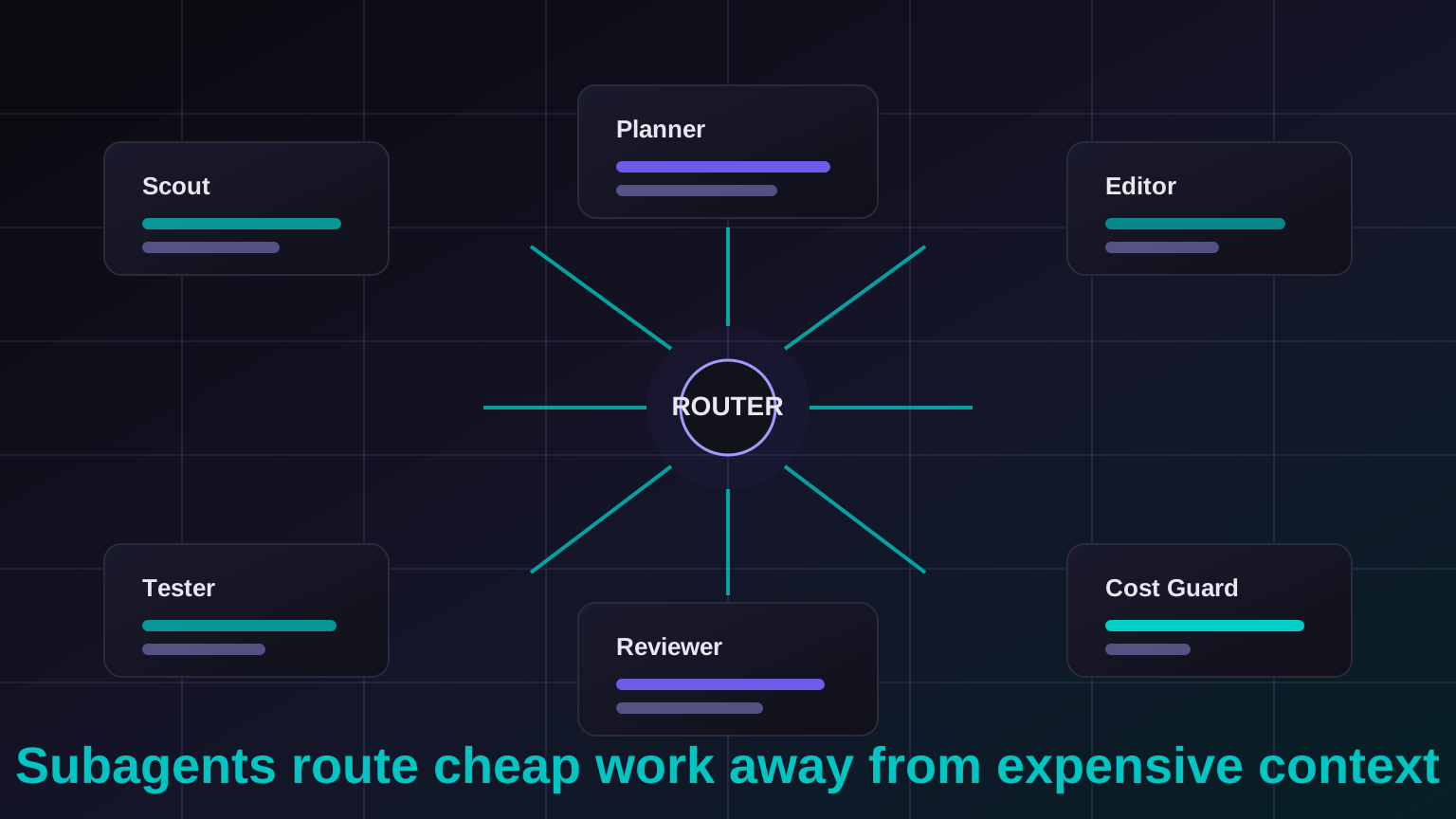
Think of your coding workflow as five roles:
- Planner: decides what needs to be done. Use your best model here.
- Scout: finds files, APIs, tests, config, and prior art. Cheap model.
- Editor: applies bounded changes. Mid-tier model is usually enough.
- Tester: reads command output and classifies failures. Cheap or mid-tier.
- Reviewer: checks correctness, security, and regression risk. Strong model.
The important part is that each role has a token ceiling. A scout doesn’t get the whole repo. A tester doesn’t paste 5,000 lines of npm noise back into the planner. A reviewer sees the diff, the relevant files, and the final test result.
Use one OpenAI-compatible gateway
The easiest way to route models is to put a gateway in front of your agents. Then every tool uses the same client code and you only change the model name. KissAPI works well for this because it exposes Claude, GPT, and other models behind an OpenAI-compatible API, so you can move traffic by config instead of rewriting your agent.
export OPENAI_API_KEY="your_kissapi_key"
export OPENAI_BASE_URL="https://api.kissapi.ai/v1"

# Example routing names in your own wrapper
export MODEL_PLANNER="claude-opus-4-7"
export MODEL_EDITOR="claude-sonnet-4-6"
export MODEL_SCOUT="gpt-5-mini"
export MODEL_TESTER="gpt-5-mini"
You don’t need to expose this complexity to every developer. Keep it in a small wrapper script, a .env profile, or your agent config.
Minimal routing wrapper in Python
This tiny router sends different task types to different models. In production you’d add logging, budgets, and retries, but the shape is enough to start.
from openai import OpenAI
import os

client = OpenAI(
    api_key=os.environ["OPENAI_API_KEY"],
    base_url=os.getenv("OPENAI_BASE_URL", "https://api.kissapi.ai/v1")
)

MODELS = {
    "plan": "claude-opus-4-7",
    "edit": "claude-sonnet-4-6",
    "scout": "gpt-5-mini",
    "test": "gpt-5-mini",
    "review": "claude-opus-4-7",
}

def run_agent(role: str, prompt: str, max_tokens: int = 1200):
    response = client.chat.completions.create(
        model=MODELS[role],
        messages=[
            {"role": "system", "content": f"You are a {role} subagent. Be brief and task-focused."},
            {"role": "user", "content": prompt},
        ],
        temperature=0.2,
        max_tokens=max_tokens,
    )
    return response.choices[0].message.content

scout_notes = run_agent("scout", "Find likely files for OAuth callback bugs. Return paths only.", 500)
plan = run_agent("plan", f"Use these notes to plan a minimal fix:\n{scout_notes}", 900)
print(plan)
Node.js version for CLI tools
If your agent runner is Node-based, the same idea is just as simple:
import OpenAI from "openai";

const client = new OpenAI({
  apiKey: process.env.OPENAI_API_KEY,
  baseURL: process.env.OPENAI_BASE_URL || "https://api.kissapi.ai/v1"
});

const models = {
  plan: "claude-opus-4-7",
  edit: "claude-sonnet-4-6",
  scout: "gpt-5-mini",
  test: "gpt-5-mini",
  review: "claude-opus-4-7"
};

export async function runSubagent(role, task, maxTokens = 1000) {
  const result = await client.chat.completions.create({
    model: models[role],
    temperature: 0.2,
    max_tokens: maxTokens,
    messages: [
      { role: "system", content: `You are a ${role} subagent. Return only useful findings.` },
      { role: "user", content: task }
    ]
  });

  return result.choices[0].message.content;
}
Context budgets that actually work
Don’t set vague rules like “be concise.” Put hard limits in your prompts and your code. A good scout output limit is 20 bullet points. A test analyzer should return the first failing assertion, the command, and the suspected cause. Nothing else.
Rule of thumb: if a subagent output is longer than the input you would have manually given the main agent, it failed its job.
For terminal coding agents, I like this budget split:
- Scout: 500-800 output tokens
- Planner: 800-1,500 output tokens
- Editor: 1,500-3,000 output tokens, or diff-only
- Tester: 400-900 output tokens
- Reviewer: 700-1,200 output tokens
Retry rules: where teams waste the most
Retries are useful, but blind retries are a money leak. Use three buckets:
- Transient: 429, 502, network timeout. Retry with exponential backoff.
- Fixable: test failed, type error, missing import. Send only the relevant error window.
- Human-needed: unclear product behavior, destructive migration, secret missing. Stop.
def classify_error(status_code: int, text: str) -> str:
    if status_code in (429, 500, 502, 503, 504):
        return "transient"
    if "AssertionError" in text or "TypeError" in text or "lint" in text.lower():
        return "fixable"
    if "permission denied" in text.lower() or "missing secret" in text.lower():
        return "human_needed"
    return "review_needed"
The biggest win is log trimming. Keep the command, exit code, last 80 lines, and any file paths mentioned. Drop the rest.
Expected savings
In a normal coding-agent session, this routing pattern often cuts token spend by 40-70%. The exact number depends on how much repo search and failed-test handling you do. If your agent spends most of its time writing one complex algorithm, savings will be smaller. If it’s browsing a monorepo, fixing CI, and reading logs, savings can be huge.
There’s also a reliability benefit. Smaller subagent tasks fail in clearer ways. When the scout is wrong, you rerun the scout. You don’t have to restart a giant all-in-one conversation that has already swallowed half your context window.
Route Claude, GPT, and more through one API
Use KissAPI as an OpenAI-compatible gateway for coding agents, subagents, fallbacks, and cost-controlled model routing. New users get free trial credits.
Start Free →Final take
The best coding-agent stack in 2026 is not one giant model doing everything. It’s a small team: a strong planner, cheap scouts, bounded editors, ruthless log trimmers, and a reviewer that only sees what matters.
Claude Code is still excellent at the high-level parts. Don’t waste it on grep, log cleanup, or formatting. Route those jobs to subagents, enforce budgets, and keep your expensive context for decisions that actually need it.