OpenAI-Compatible API Fallback Routing Guide (2026): Keep Apps Online During 429s and Outages
If your app calls one model through one provider and treats that provider as always available, you don't have an AI architecture. You have a single point of failure with a nicer SDK.
Rate limits, short outages, regional issues, overloaded models, and surprise quota changes are normal now. OpenAI's own rate-limit docs frame limits as a core part of API usage, and status pages report availability at an aggregate level rather than promising your exact model and tier will behave the same every minute. That isn't a complaint. It's just the reality of building on fast-moving AI infrastructure.
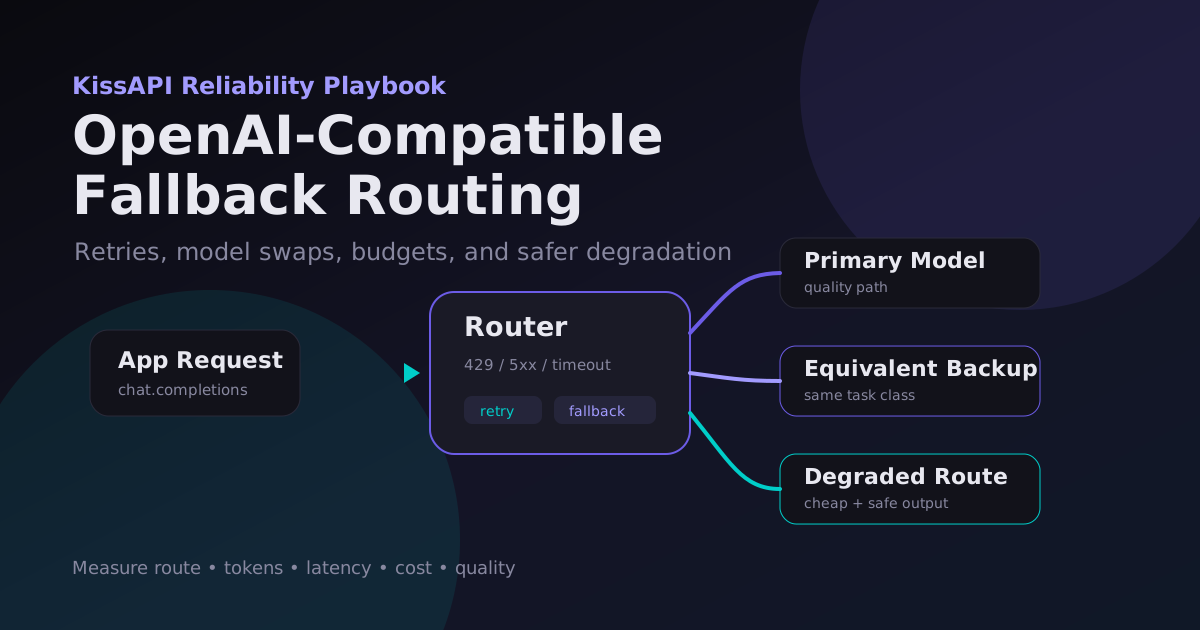
The fix is fallback routing: when a request fails for a recoverable reason, your app can retry, switch model, switch provider, or degrade gracefully. The OpenAI-compatible API format makes this easier because many gateways and model providers accept the same basic request shape. But you still need rules. Blindly retrying everything is how you create duplicate charges, slow user experiences, and weird output drift.
The Failure Cases Worth Routing Around
Not every error deserves a fallback. Start by splitting failures into four buckets:
| Failure | Typical Signal | Best Action |
|---|---|---|
| Rate limit | 429, quota exceeded, retry headers | Backoff, then route to backup if latency matters |
| Temporary outage | 502, 503, timeout | Retry once, then fallback |
| Bad request | 400, invalid schema, unsupported parameter | Fix request; don't fallback blindly |
| Quality mismatch | Valid response, wrong style or weak answer | Use evals, not transport retry logic |
The important line is the third one. If your request includes a parameter the backup model doesn't support, a fallback won't save you unless you normalize the payload first.
A Practical Routing Policy
I like a simple three-lane policy:
- Primary route: your preferred model for quality, latency, and cost.
- Equivalent fallback: a close model for the same task class.
- Degraded fallback: a cheaper or simpler model that can still produce an acceptable answer.
For example, a support summarizer might use a flagship model for messy enterprise tickets, a fast mid-tier model for normal tickets, and a cheap model for short internal summaries. A coding agent might keep GPT-5.5 or Claude as the primary path, then fallback based on context length, tool support, and cost.
Good fallback routing is not "try random model B." It's "for this task, under this failure mode, use this backup and strip these unsupported fields."
Minimal curl Example
Most OpenAI-compatible chat endpoints use the same base pattern. Here is the primary request:
curl https://api.example.com/v1/chat/completions \
  -H "Authorization: Bearer $API_KEY" \
  -H "Content-Type: application/json" \
  -d '{
    "model": "gpt-5.5",
    "messages": [
      {"role": "system", "content": "Summarize support tickets clearly."},
      {"role": "user", "content": "Summarize this ticket: ..."}
    ],
    "temperature": 0.2
  }'
A fallback request should not be a copy-paste with only the model changed. Normalize it:
curl https://backup.example.com/v1/chat/completions \
  -H "Authorization: Bearer $BACKUP_API_KEY" \
  -H "Content-Type: application/json" \
  -d '{
    "model": "claude-sonnet-4-6",
    "messages": [
      {"role": "system", "content": "Summarize support tickets clearly. Return bullet points."},
      {"role": "user", "content": "Summarize this ticket: ..."}
    ]
  }'
Notice that the backup example removes optional knobs. That matters. Some OpenAI-compatible endpoints accept the common fields but reject provider-specific extras.
Python: Retry Once, Then Fallback
This is the small version you can drop into a service. In production, send the logs to your observability stack, not print.
import os
import time
from openai import OpenAI

primary = OpenAI(
    api_key=os.environ["PRIMARY_API_KEY"],
    base_url="https://api.primary.example/v1",
)

backup = OpenAI(
    api_key=os.environ["BACKUP_API_KEY"],
    base_url="https://api.kissapi.ai/v1",
)

RETRYABLE_STATUS = {408, 409, 429, 500, 502, 503, 504}


def call_chat(messages, request_id):
    try:
        return primary.chat.completions.create(
            model="gpt-5.5",
            messages=messages,
            temperature=0.2,
            extra_headers={"Idempotency-Key": request_id},
            timeout=20,
        )
    except Exception as error:
        status = getattr(error, "status_code", None)
        if status not in RETRYABLE_STATUS:
            raise

        time.sleep(0.8)
        try:
            return primary.chat.completions.create(
                model="gpt-5.5",
                messages=messages,
                temperature=0.2,
                extra_headers={"Idempotency-Key": request_id + "-retry"},
                timeout=20,
            )
        except Exception as second_error:
            second_status = getattr(second_error, "status_code", None)
            if second_status not in RETRYABLE_STATUS:
                raise

            return backup.chat.completions.create(
                model="claude-sonnet-4-6",
                messages=messages,
                timeout=25,
            )
KissAPI fits well as a backup route here because it exposes an OpenAI-compatible endpoint while giving you access to multiple frontier models behind one account. Use it as a spare path, a cost-control layer, or both. The boring operational win is that your app code doesn't need a new SDK every time you change routes.
Node.js: A Tiny Router Object
Once you have more than two routes, make routing explicit. Don't hide it in random catch blocks.
import OpenAI from "openai";

const routes = [
  {
    name: "primary-gpt55",
    model: "gpt-5.5",
    client: new OpenAI({
      apiKey: process.env.PRIMARY_API_KEY,
      baseURL: "https://api.primary.example/v1"
    })
  },
  {
    name: "backup-sonnet",
    model: "claude-sonnet-4-6",
    client: new OpenAI({
      apiKey: process.env.KISSAPI_KEY,
      baseURL: "https://api.kissapi.ai/v1"
    })
  }
];

const retryable = new Set([408, 409, 429, 500, 502, 503, 504]);

export async function routedChat(messages) {
  const errors = [];

  for (const route of routes) {
    try {
      const response = await route.client.chat.completions.create({
        model: route.model,
        messages,
        temperature: 0.2
      });

      return { route: route.name, response };
    } catch (error) {
      const status = error.status || error.statusCode;
      errors.push({ route: route.name, status, message: error.message });
      if (!retryable.has(status)) break;
    }
  }

  throw new Error(`All AI routes failed: ${JSON.stringify(errors)}`);
}
The returned route name is not trivia. Store it. Later, when someone asks why support summaries got shorter on Tuesday, you'll know whether the backup path was active.
What to Log
At minimum, log these fields for every AI request:
request_idand user/session ID hash- route name, model, base URL group, and fallback attempt number
- HTTP status, timeout flag, and provider error code
- input tokens, output tokens, and estimated cost
- latency to first byte and full completion latency
Use the token counter before deployment to estimate context size, then use the API cost calculator to compare primary and fallback routes. The point isn't perfect accounting. The point is spotting bad defaults before they become a $900 surprise.
Rules That Prevent Bad Fallbacks
- Never fallback unsafe tasks silently. If the task is legal, medical, payment, or account security related, fail closed or require review.
- Keep output contracts stable. If the caller expects JSON, validate JSON after fallback too.
- Strip unsupported parameters. Tool calls, response formats, reasoning flags, and audio fields vary by provider.
- Set a latency budget. Two retries plus one fallback can turn a 4-second answer into a 45-second hang.
- Prefer task-based routing over model fandom. Different models win different jobs.
FAQ
What is OpenAI-compatible API fallback routing?
It's a reliability pattern where your app retries or reroutes failed LLM requests to another model or provider that supports the OpenAI API shape. The usual triggers are 429, 5xx, timeout, or temporary model availability errors.
Should every AI request use fallback routing?
No. Use it where uptime matters and output drift is acceptable. For sensitive or high-risk work, a clear failure is often better than a silent model swap.
Can fallback routing reduce API cost?
Yes. You can reserve premium models for hard requests and route routine work to cheaper models. Just measure quality and cost together. Cheap wrong answers are still expensive.
Need a Backup AI API Route?
Create a free KissAPI account and test an OpenAI-compatible fallback endpoint before the next rate-limit spike hits production.
Start Free