Gemini API Rate Limit Fallback Routing Guide 2026: Keep Apps Online During 429 Spikes
Gemini is a great API until your app hits a wall at exactly the wrong moment. A demo goes viral. A batch job wakes up. A coding agent gets stuck in a retry loop. Suddenly the clean request path you tested all week turns into a pile of 429 RESOURCE_EXHAUSTED responses.
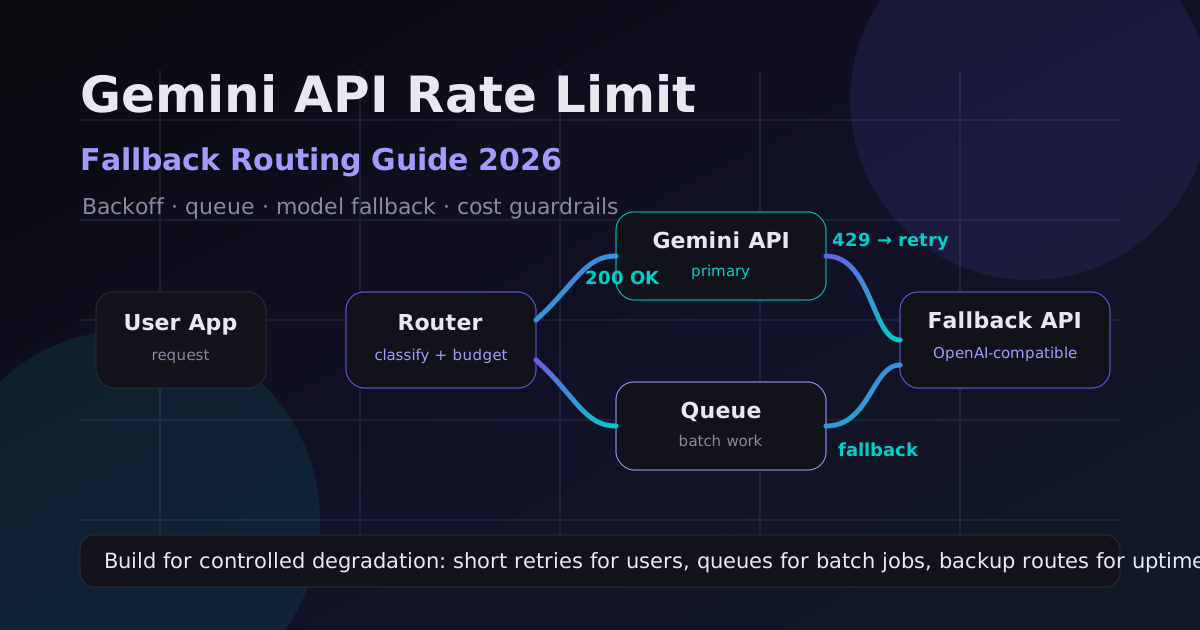
The fix is not “retry harder.” That usually makes the outage worse. You need a small routing layer that can slow down, queue work, switch models, and fail over to a backup provider when the user experience matters more than provider purity.
This guide shows a practical Gemini API rate limit fallback design for 2026. It uses normal HTTP habits, not magic: backoff, jitter, task classes, queues, and a backup OpenAI-compatible route. You can implement the first version in an afternoon.
Start by Sorting Requests by Urgency
Rate limits hurt most when every request is treated as equally important. They aren't. A user waiting in a chat box deserves a different path than a nightly embedding refresh.
| Request Type | Example | Best Response to 429 |
|---|---|---|
| Interactive | Chat, IDE assistant, support bot | Short retry, then fallback |
| Near-real-time | Ticket classification, content moderation | Retry with queue delay |
| Batch | Summaries, indexing, eval jobs | Queue and run later |
| Optional | Autocomplete, suggestions | Drop or downgrade |
This one table should drive your router. If you skip it, your batch jobs will happily steal capacity from paying users.
What a Good 429 Handler Actually Does
A good handler has four moves:
- Respect provider hints. If the response includes
Retry-After, use it. - Add jitter. Without randomness, all workers retry at the same time.
- Cap retries. Most user-facing calls should not sit around for 60 seconds.
- Escalate by task class. Interactive calls can fallback. Batch calls can wait.
The goal is controlled degradation. Users may get a slightly different model for one request. That's better than a spinner that never ends.
Minimal curl Test for a Gemini-Style Request
Before adding routing logic, keep a small smoke test around. It catches bad keys, wrong endpoints, and model name mistakes before you blame rate limits.
curl "https://generativelanguage.googleapis.com/v1beta/models/gemini-2.5-pro:generateContent?key=$GEMINI_API_KEY" \
  -H "Content-Type: application/json" \
  -d '{
    "contents": [{
      "parts": [{"text": "Write one sentence about API fallback routing."}]
    }]
  }'
For production apps, wrap this behind your own client. You don't want raw provider-specific request shapes scattered through a codebase.
Python: Retry Gemini, Then Fall Back
Here's a small version using httpx. It retries Gemini twice with jitter. If the call is interactive and still rate-limited, it falls back to an OpenAI-compatible endpoint.
import os, random, time
import httpx

GEMINI_URL = "https://generativelanguage.googleapis.com/v1beta/models/gemini-2.5-pro:generateContent"
BACKUP_URL = "https://api.kissapi.ai/v1/chat/completions"


def sleep_for_retry(response, attempt):
    retry_after = response.headers.get("retry-after")
    if retry_after:
        delay = min(float(retry_after), 8.0)
    else:
        delay = min(0.5 * (2 ** attempt), 6.0)
    time.sleep(delay + random.uniform(0, 0.4))


def ask_gemini(prompt):
    params = {"key": os.environ["GEMINI_API_KEY"]}
    body = {"contents": [{"parts": [{"text": prompt}]}]}
    for attempt in range(3):
        response = httpx.post(GEMINI_URL, params=params, json=body, timeout=30)
        if response.status_code != 429:
            response.raise_for_status()
            return response.json()["candidates"][0]["content"]["parts"][0]["text"]
        sleep_for_retry(response, attempt)
    raise RuntimeError("gemini_rate_limited")


def ask_backup(prompt):
    response = httpx.post(
        BACKUP_URL,
        headers={"Authorization": f"Bearer {os.environ['KISSAPI_API_KEY']}"},
        json={
            "model": "claude-sonnet-4-6",
            "messages": [{"role": "user", "content": prompt}],
            "max_tokens": 600
        },
        timeout=30
    )
    response.raise_for_status()
    return response.json()["choices"][0]["message"]["content"]


def complete(prompt, task_class="interactive"):
    try:
        return ask_gemini(prompt)
    except RuntimeError:
        if task_class == "interactive":
            return ask_backup(prompt)
        raise
This is intentionally plain. Add logging, circuit breakers, and budgets before you run it at scale.
Node.js: Put the Router in One Place
The mistake I see in Node apps is provider logic duplicated across controllers, workers, and cron jobs. Put routing in one module instead.
const sleep = (ms) => new Promise((resolve) => setTimeout(resolve, ms));

async function gemini(prompt) {
  const url = `https://generativelanguage.googleapis.com/v1beta/models/gemini-2.5-pro:generateContent?key=${process.env.GEMINI_API_KEY}`;
  const res = await fetch(url, {
    method: "POST",
    headers: { "content-type": "application/json" },
    body: JSON.stringify({ contents: [{ parts: [{ text: prompt }] }] })
  });
  if (res.status === 429) throw new Error("RATE_LIMITED");
  if (!res.ok) throw new Error(`Gemini failed: ${res.status}`);
  const data = await res.json();
  return data.candidates[0].content.parts[0].text;
}

async function backup(prompt) {
  const res = await fetch("https://api.kissapi.ai/v1/chat/completions", {
    method: "POST",
    headers: {
      "content-type": "application/json",
      authorization: `Bearer ${process.env.KISSAPI_API_KEY}`
    },
    body: JSON.stringify({
      model: "gpt-5",
      messages: [{ role: "user", content: prompt }],
      max_tokens: 600
    })
  });
  if (!res.ok) throw new Error(`Backup failed: ${res.status}`);
  const data = await res.json();
  return data.choices[0].message.content;
}

export async function complete(prompt, { interactive = true } = {}) {
  for (let attempt = 0; attempt < 2; attempt++) {
    try {
      return await gemini(prompt);
    } catch (err) {
      if (err.message !== "RATE_LIMITED") throw err;
      await sleep(400 * 2 ** attempt + Math.random() * 250);
    }
  }
  if (interactive) return backup(prompt);
  throw new Error("Queued for later: Gemini rate limited");
}
Notice the fallback model is not trying to be identical. That's fine. For many app flows, a safe answer now beats a perfect answer after the user has left.
When to Downgrade, Queue, or Switch Provider
Use a simple decision tree:
| Condition | Action |
|---|---|
| User is waiting | Retry briefly, then fallback |
| Task is cheap and non-critical | Switch to a smaller model |
| Task is expensive but not urgent | Queue it |
| Multiple providers are failing | Return a clear degraded-mode message |
The worst option is invisible failure. If a background task is queued, mark it queued. If an answer used a fallback model, log it. Don't make future debugging a guessing game.
Add Budget Checks Before Fallback
Fallback saves reliability, but it can raise cost if you switch from a cheap model to a more expensive one on every spike. Add three checks:
- Per-request max tokens: cap output tokens for fallback responses.
- Per-user daily spend: stop one user from burning through the account.
- Global emergency cap: pause optional work when daily spend crosses a hard limit.
Use the API cost calculator before you pick fallback models, then check prompts with the token counter. Most surprise bills start as “temporary” fallback rules nobody measured.
Where KissAPI Fits
If you want one backup route without rewriting your app around every provider's native format, an OpenAI-compatible gateway helps. KissAPI lets you call models such as GPT-5, GPT-5.5, and Claude Sonnet 4.6 through a familiar chat completions shape. That makes fallback easier to test and easier to remove if you later change strategy.
Don't route everything through a fallback by default. Keep Gemini as primary if it fits your product. Just don't make Gemini your only way to answer a customer when rate limits spike.
FAQ
What is the safest way to handle Gemini API 429 errors?
Use a short exponential backoff with jitter, respect Retry-After when it appears, cap total retry time, and move non-urgent work into a queue. Retrying forever is not reliability. It's a self-inflicted traffic jam.
Should I switch models when Gemini rate limits are hit?
Yes, when the task can tolerate it. Summaries, extraction, classification, and drafts usually survive a model switch. Final reasoning, legal text, medical content, and customer-visible decisions need stricter rules.
Can an OpenAI-compatible API gateway help with fallback routing?
Yes. A gateway gives your app one request format while routing traffic across multiple model providers. That reduces adapter code and makes fallback behavior easier to test in staging.
Build a Safer Backup Route
Create a free KissAPI account and test an OpenAI-compatible fallback path before your next 429 spike hits production.
Start Free