GPT-5.6 API Model Routing Guide (2026): Sol vs Terra vs Luna
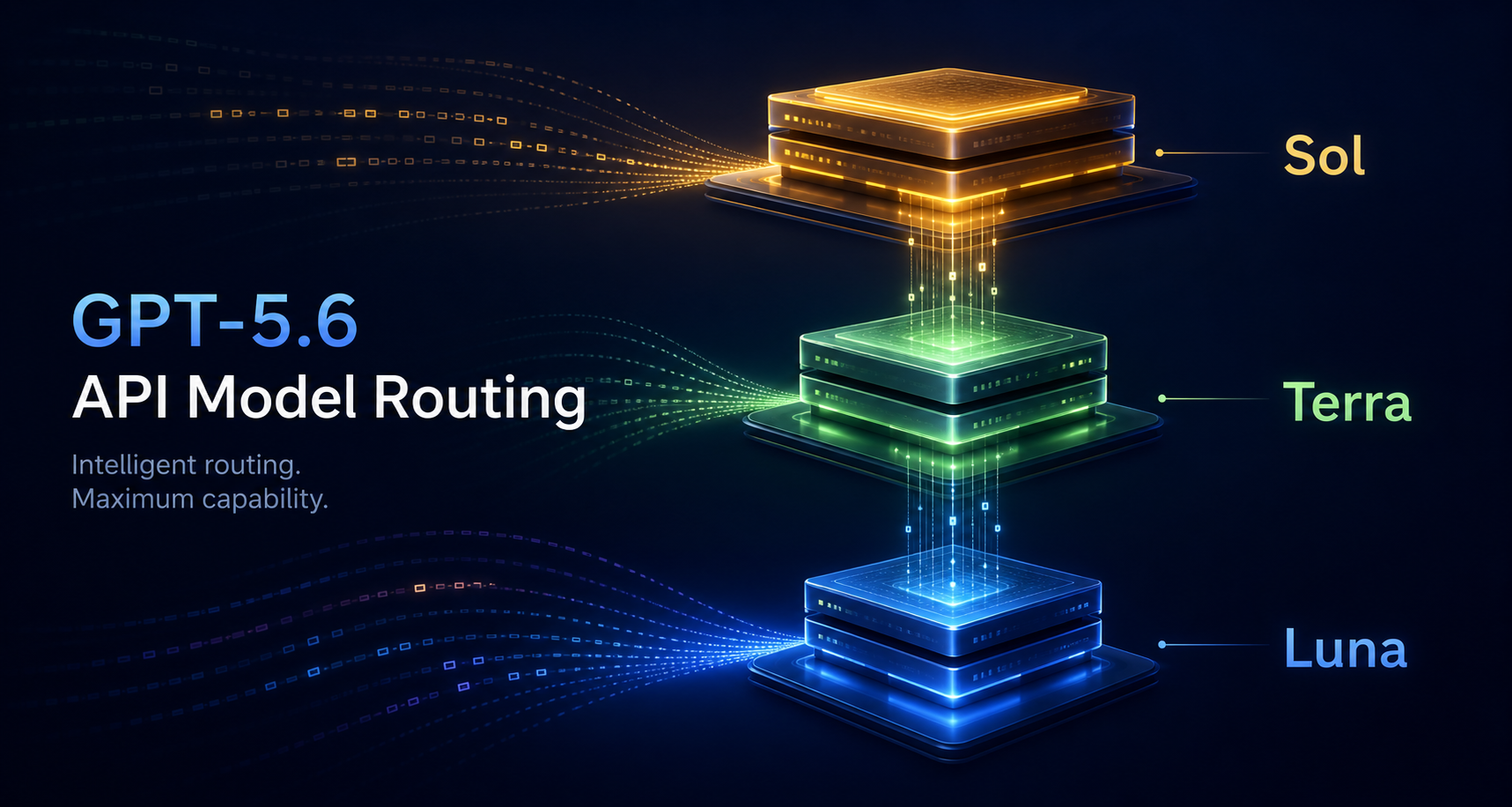
OpenAI moved the GPT-5.6 family to general availability on July 9, 2026, after a limited preview that started on June 26. The launch matters less because there is a new flagship model and more because OpenAI split the family into three explicit API tiers: GPT-5.6 Sol for high-value reasoning, GPT-5.6 Terra for balanced everyday work, and GPT-5.6 Luna for high-volume cost-sensitive jobs.
That is a gift to developers if you use it properly. It is also an easy way to burn money if you point every request at Sol because it feels safest. The better pattern is boring: route by task value, context size, latency tolerance, and failure cost. This guide gives you the practical version.
TL;DR: Key Takeaways
- OpenAI made GPT-5.6 Sol, GPT-5.6 Terra, and GPT-5.6 Luna generally available for the OpenAI API on July 9, 2026.
- GPT-5.6 Sol costs $5.00 per million input tokens and $30.00 per million output tokens with a 1,050,000-token context window.
- GPT-5.6 Terra costs $2.50 per million input tokens and $15.00 per million output tokens with a 1,050,000-token context window.
- GPT-5.6 Luna costs $1.00 per million input tokens and $6.00 per million output tokens with a 1,050,000-token context window.
- Prompts above 272,000 input tokens are priced at 2x input and 1.5x output for GPT-5.6 Sol and GPT-5.6 Terra according to OpenAI's model pages.
GPT-5.6 API Pricing Table
| Model | Input price | Cached input | Output price | Context window |
|---|---|---|---|---|
| GPT-5.6 Sol | $5.00 / 1M tokens | $0.50 / 1M tokens | $30.00 / 1M tokens | 1,050,000 tokens |
| GPT-5.6 Terra | $2.50 / 1M tokens | $0.25 / 1M tokens | $15.00 / 1M tokens | 1,050,000 tokens |
| GPT-5.6 Luna | $1.00 / 1M tokens | $0.10 / 1M tokens | $6.00 / 1M tokens | 1,050,000 tokens |
| GPT-5.5 | $5.00 / 1M tokens short context; $10.00 / 1M tokens long context | $0.50 short; $1.00 long | $30.00 short; $45.00 long | 1,050,000 tokens |
Model and Option Comparison
| Option | Best for | Input/output price | Key limitation | Default routing rule |
|---|---|---|---|---|
| GPT-5.6 Sol | Complex coding agents, high-stakes analysis, tool-heavy research, cybersecurity workflows | $5.00 / $30.00 per 1M tokens | Highest GPT-5.6 cost; long prompts above 272K tokens trigger the higher long-context multiplier | Use only when the answer quality or automation success rate is worth the premium |
| GPT-5.6 Terra | General product features, support reasoning, document extraction, code review drafts | $2.50 / $15.00 per 1M tokens | Not the cheapest tier and not the strongest tier | Use as the default model for mixed workloads until data proves otherwise |
| GPT-5.6 Luna | Classification, transformation, short customer support drafts, batch enrichment | $1.00 / $6.00 per 1M tokens | Less suitable for long-horizon reasoning and ambiguous agent plans | Use first for high-volume well-defined tasks, then escalate failures |
| GPT-5.5 | Legacy workflows already tuned for GPT-5.5 behavior | $5.00 / $30.00 short context; $10.00 / $45.00 long context | Older family; long-context pricing is more expensive than short-context pricing | Keep for compatibility, then migrate endpoint by endpoint |
The Routing Rule I Would Start With
Start with Terra as the default, Luna as the cheap path, and Sol as the escalation path. That sounds conservative, but it usually beats the two common mistakes: routing everything to the flagship, or forcing every task through the cheapest model and paying for bad retries.
For example, a support automation pipeline might classify every ticket with Luna, draft medium-risk replies with Terra, and send refund disputes or legal language to Sol. A coding workflow might use Luna for file summaries, Terra for first-pass patch generation, and Sol for final architecture review. You do not need a complicated router on day one. You need a few honest labels.
Minimal curl Example
curl https://api.openai.com/v1/responses \
  -H "Authorization: Bearer $OPENAI_API_KEY" \
  -H "Content-Type: application/json" \
  -d '{
    "model": "gpt-5.6-terra",
    "input": "Summarize this pull request and list the riskiest files first..."
  }'
If you use KissAPI as an OpenAI-compatible gateway, keep the request shape almost identical and change the base URL and key. That makes it easier to test fallback routing without rewriting your app.
Python: A Simple Escalation Router
from openai import OpenAI

client = OpenAI(api_key="YOUR_KEY")

def choose_model(task):
    if task["risk"] == "high" or task.get("requires_tools"):
        return "gpt-5.6-sol"
    if task["volume"] == "high" and task["format"] == "strict":
        return "gpt-5.6-luna"
    return "gpt-5.6-terra"

def run_task(task):
    model = choose_model(task)
    response = client.responses.create(
        model=model,
        input=task["prompt"]
    )
    return response.output_text
This is deliberately plain. Fancy routers that nobody understands become a debugging tax. Keep the first version readable, log the chosen model, and measure cost per successful task rather than cost per token alone.
Node.js: Add a Fallback Path
import OpenAI from "openai";

const primary = new OpenAI({ apiKey: process.env.OPENAI_API_KEY });
const backup = new OpenAI({
  apiKey: process.env.KISSAPI_API_KEY,
  baseURL: "https://api.kissapi.ai/v1"
});

export async function askWithFallback(input) {
  try {
    return await primary.responses.create({
      model: "gpt-5.6-terra",
      input
    });
  } catch (err) {
    if (![429, 500, 502, 503, 504].includes(err.status)) throw err;
    return await backup.chat.completions.create({
      model: "gpt-5.5",
      messages: [{ role: "user", content: input }]
    });
  }
}
The backup does not need to be identical. It needs to be good enough for graceful degradation. For production apps, record which path served each request and alert when fallback usage jumps.
Watch the 272K Token Boundary
OpenAI's GPT-5.6 Sol and Terra model pages say prompts above 272,000 input tokens are priced at 2x input and 1.5x output for the full request. That is the kind of detail that wrecks cost projections if you only look at the headline price.
Before you migrate long-context agents, run a token distribution report. If most requests are under 100K tokens, the headline rates are fine. If your app regularly stuffs entire repositories, logs, or document sets into one call, use a token counter and split work before the boundary. The KissAPI token counter is useful for quick checks, and the API cost calculator helps compare Sol, Terra, Luna, and fallback models before you ship.
Want GPT-5.6-style Routing Without Rebuilding Your Stack?
Create a free KissAPI account and test OpenAI-compatible fallback routes for Claude, GPT, Gemini, and other models from one API key.
Start FreeFAQ
Is GPT-5.6 Sol the same as gpt-5.6?
OpenAI's GPT-5.6 Sol model page says the gpt-5.6 alias routes requests to gpt-5.6-sol. Use explicit model IDs in production when you want stable routing behavior.
Should I replace GPT-5.5 with GPT-5.6 immediately?
No. Migrate endpoint by endpoint. Start with low-risk workloads, compare cost per successful task, then move higher-risk jobs after prompt and eval checks pass.
Which GPT-5.6 tier is best for API cost control?
GPT-5.6 Luna is the lowest-cost GPT-5.6 tier at $1.00 per million input tokens and $6.00 per million output tokens. Use it for high-volume tasks with clear formats and low ambiguity.