Claude Opus 4.8 API Access Guide 2026: What's New, Pricing & Code Examples
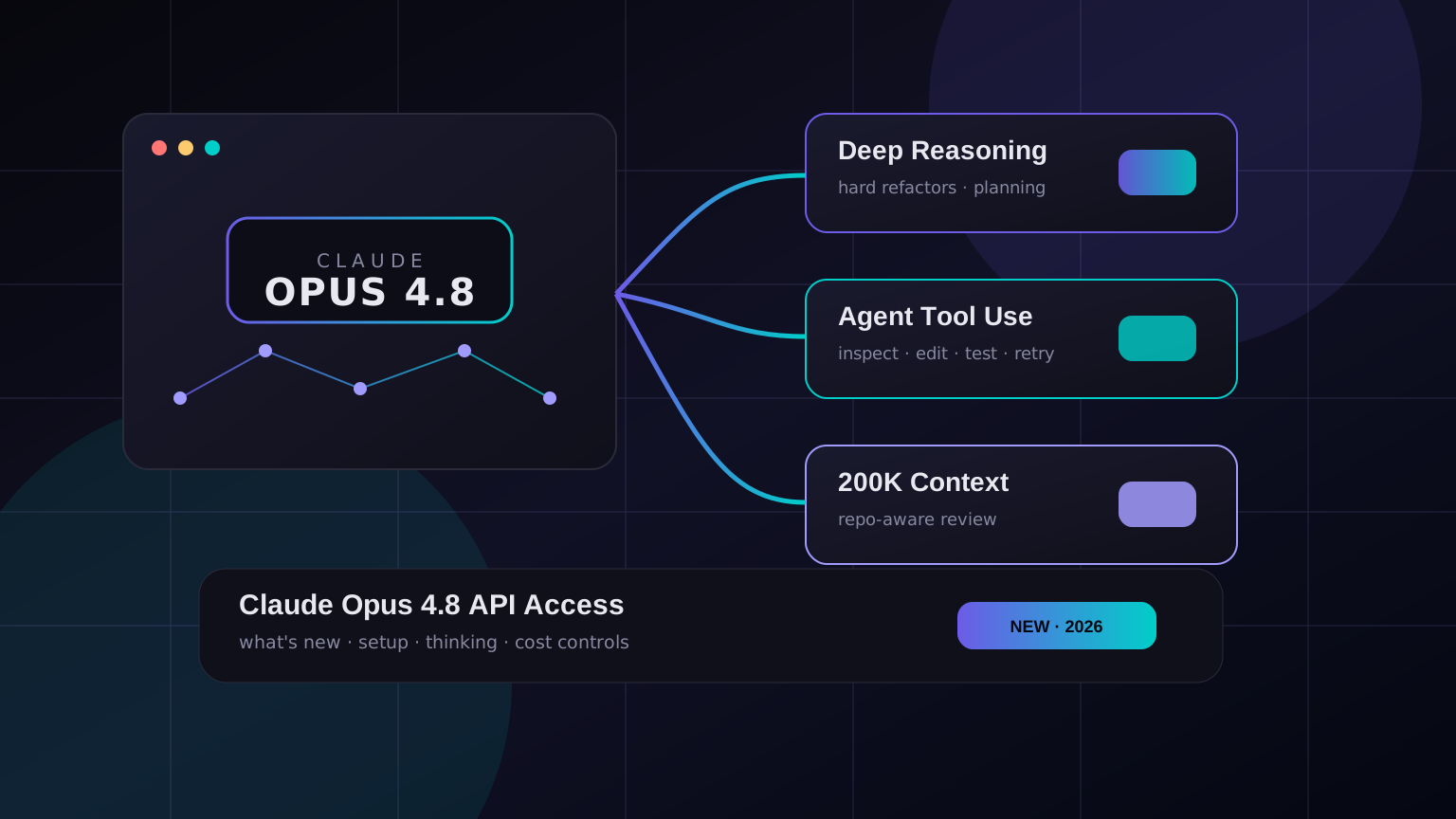
Claude Opus 4.8 is here, and it's already live on KissAPI. If Opus 4.7 was the model you reached for when a task had too many moving parts for the cheaper options, 4.8 is the same idea with a sharper edge: better long-context reasoning, fewer "almost right" patches on big refactors, and more reliable tool use when an agent has to chain a dozen steps without losing the thread.
This guide is for developers who want Claude Opus 4.8 API access today, without turning setup into a weekend project. We'll cover what actually changed, how to call it through OpenAI-compatible and Anthropic-style endpoints, how to use its extended-thinking variant, and the cost controls worth putting in place before you point a coding agent at it.
What's new in Opus 4.8
Anthropic's point releases rarely reinvent the model. They sharpen it. With 4.8, the differences you'll feel in real work are practical rather than flashy:
- Steadier long-context reasoning. On big repos and long debugging sessions, 4.8 holds the thread better. Fewer moments where the model forgets a constraint you set 40 messages ago.
- Cleaner multi-step tool use. Agent chains (inspect → plan → edit → test → retry) hold together more reliably. Less drift, fewer "confidently wrong" detours mid-task.
- Tighter patches on hard refactors. The kind of multi-file change where a subtle mistake breaks a migration is exactly where 4.8 earns its price.
- Extended thinking, refined. The
claude-opus-4-8-thinkingvariant gives you adaptive reasoning depth for genuinely hard problems, and it's available on KissAPI from day one.
Context window: Opus 4.8 supports a 200K-token context window on KissAPI. That's enough for large files, long logs, and multi-file diffs, but it's still a budget you should spend deliberately rather than dumping an entire repo into every call.
When to use Claude Opus 4.8
Don't use Opus 4.8 for every request. That's the fastest way to make a great model look "too expensive." Use it where the extra reasoning actually changes the result.
| Task | Use Opus 4.8? | Better default |
|---|---|---|
| Multi-file refactor with hidden dependencies | Yes | Opus 4.8 |
| Debugging a flaky production incident | Yes | Opus 4.8 or Sonnet with escalation |
| Simple code completion | No | Fast coding model |
| PR summary | No | Cheap general model |
| Security review of auth/payment code | Yes | Opus 4.8, with human review |
| JSON extraction or tagging | No | Small model |
The rule hasn't changed since 4.7: Opus is for expensive mistakes, not expensive words. If a wrong answer can break a migration, ship a subtle auth bug, or waste a senior engineer's afternoon, pay for the stronger model. If the task is formatting, classifying, or summarizing, route it down.
Pricing notes developers should care about
Exact pricing varies by provider and plan, but the pattern is stable: Opus-class models cost more than mid-tier coding models, especially on output tokens. Your biggest bill driver is usually not "asking questions." It's letting agents produce long plans, long diffs, repeated retries, and full-file rewrites.
Practical budget rule: start with a per-task budget. Allow Opus 4.8 for one planning turn and one patch turn. If tests still fail, require a human checkpoint before another expensive call.
Through a gateway like KissAPI, you keep one OpenAI-compatible endpoint for multiple models and route only the hard steps to Opus 4.8. That matters in real coding-agent workflows because the "agent" is rarely one request. It's a chain of inspect, plan, edit, test, retry, summarize, and most of those steps don't need a flagship model.
Option 1: OpenAI-compatible endpoint
Most developer tools are built around OpenAI's SDK shape. An OpenAI-compatible gateway is the simplest path: keep your client library, change the base URL, and set the model name.
curl https://api.kissapi.ai/v1/chat/completions \
  -H "Authorization: Bearer $KISSAPI_API_KEY" \
  -H "Content-Type: application/json" \
  -d '{
    "model": "claude-opus-4-8",
    "messages": [
      {"role": "system", "content": "You are a senior backend engineer. Be concise."},
      {"role": "user", "content": "Find the bug in this retry strategy: ..."}
    ],
    "temperature": 0.2
  }'
This is the setup I prefer for mixed-model stacks. It works well when one app needs Claude for deep reasoning, GPT-style models for tool-heavy tasks, and cheaper models for summaries.
Option 2: Anthropic-style API call
If your tooling already expects Anthropic variables, the request looks like this:
curl https://api.kissapi.ai/v1/messages \
  -H "x-api-key: $CLAUDE_API_KEY" \
  -H "anthropic-version: 2023-06-01" \
  -H "content-type: application/json" \
  -d '{
    "model": "claude-opus-4-8",
    "max_tokens": 1200,
    "messages": [
      {
        "role": "user",
        "content": "Review this database migration for data-loss risks. Be specific."
      }
    ]
  }'
Use this style when your tool already expects Anthropic variables such as ANTHROPIC_API_KEY or ANTHROPIC_BASE_URL. Claude Code setups often fall into this bucket.
Using the extended-thinking variant
For genuinely hard problems, point at claude-opus-4-8-thinking. It uses adaptive reasoning depth, so it spends more thinking budget on hard steps and less on easy ones. Reserve it for the cases where a normal pass keeps coming back shallow.
curl https://api.kissapi.ai/v1/chat/completions \
  -H "Authorization: Bearer $KISSAPI_API_KEY" \
  -H "Content-Type: application/json" \
  -d '{
    "model": "claude-opus-4-8-thinking",
    "messages": [
      {"role": "user", "content": "Design a migration plan from a monolith auth service to OIDC without downtime. List risks."}
    ]
  }'
Python example
The official OpenAI Python SDK works with compatible gateways as long as you set base_url. Keep the model configurable so you can escalate only when needed.
from openai import OpenAI
import os

client = OpenAI(
    api_key=os.environ["KISSAPI_API_KEY"],
    base_url="https://api.kissapi.ai/v1"
)

response = client.chat.completions.create(
    model=os.getenv("REASONING_MODEL", "claude-opus-4-8"),
    messages=[
        {"role": "system", "content": "You review code for correctness and security."},
        {"role": "user", "content": "Review this auth middleware patch:\n\n..."}
    ],
    temperature=0.1,
)

print(response.choices[0].message.content)
Node.js example
Same idea in Node. The important bit is not the SDK; it's the contract around the call: small input, clear task, bounded output.
import OpenAI from "openai";

const client = new OpenAI({
  apiKey: process.env.KISSAPI_API_KEY,
  baseURL: "https://api.kissapi.ai/v1",
});

const result = await client.chat.completions.create({
  model: "claude-opus-4-8",
  temperature: 0.1,
  messages: [
    { role: "system", content: "Act as a careful TypeScript reviewer." },
    { role: "user", content: "Review this diff for race conditions:\n\n" + diff.slice(0, 60000) }
  ],
});

console.log(result.choices[0].message.content);
Using Opus 4.8 with Claude Code
For Claude Code or similar CLI tools, start with environment variables instead of editing random config files. It's easier to rotate keys and safer on shared machines.
export ANTHROPIC_API_KEY="$YOUR_KEY"
export ANTHROPIC_BASE_URL="https://api.kissapi.ai"
export ANTHROPIC_MODEL="claude-opus-4-8"
Then test with a narrow prompt before opening a full repository session:
claude "Read package.json and explain the test command. Do not edit files."If that works, move to a small patch. Don't open with "analyze the entire repo." It feels productive, but it usually just dumps noise into the context window.
Cost controls before production
- Use escalation. Start with Sonnet or a cheaper coding model. Escalate to Opus 4.8 only after a failed test, a risky file match, or an explicit label.
- Limit context. Send diffs, relevant files, and recent logs. Not the whole repo. Not 5,000 lines of CI output.
- Cap output. Ask for one patch or one review. Long essays are expensive and hard to act on.
- Classify errors. Retry 429 and 5xx with backoff. Don't blindly retry 401, 403, invalid model, or context-length errors.
- Log usage. Store model, tokens, latency, status code, and task type. Without this, you're guessing.
def choose_model(task):
    if task["risk"] == "high" or task["files_touched"] > 8:
        return "claude-opus-4-8"
    if task["type"] in {"summary", "label", "changelog"}:
        return "cheap-fast-model"
    return "claude-sonnet-4-6"
A sane routing pattern
Here's a simple routing setup for coding agents:
| Agent step | Recommended model | Reason |
|---|---|---|
| Issue summary | Cheap fast model | No deep reasoning needed. |
| Repo inspection | Sonnet-class model | Good balance for reading code. |
| Patch planning | Opus 4.8 for risky tasks | Architecture mistakes are costly. |
| Patch generation | Sonnet or Opus by risk | Keep edits small either way. |
| Final explanation | Cheap model | The hard work is already done. |
Less glamorous than "one supermodel does everything," but it holds up better in production. You get quality where it matters and keep routine traffic cheap.
Start Building with Claude Opus 4.8
Opus 4.8 is live on KissAPI right now. Access it and other leading models through one OpenAI-compatible API, with flexible routing for coding agents, CI, and production apps. New accounts start with free credit.
Start Free →Bottom line
Claude Opus 4.8 is a real step up for hard developer work: steadier long-context reasoning, cleaner multi-step tool use, and tighter patches on the refactors where mistakes are expensive. It should still not be your default for every token.
Set up access once, then build a small routing layer around it: a cheap model for summaries, a Sonnet-class model for normal code work, and Opus 4.8 for the moments where being wrong actually costs you. That's the boring answer. It's also the one that keeps the bill under control.